What Is an MVP - Building the Smallest Product That Creates Value
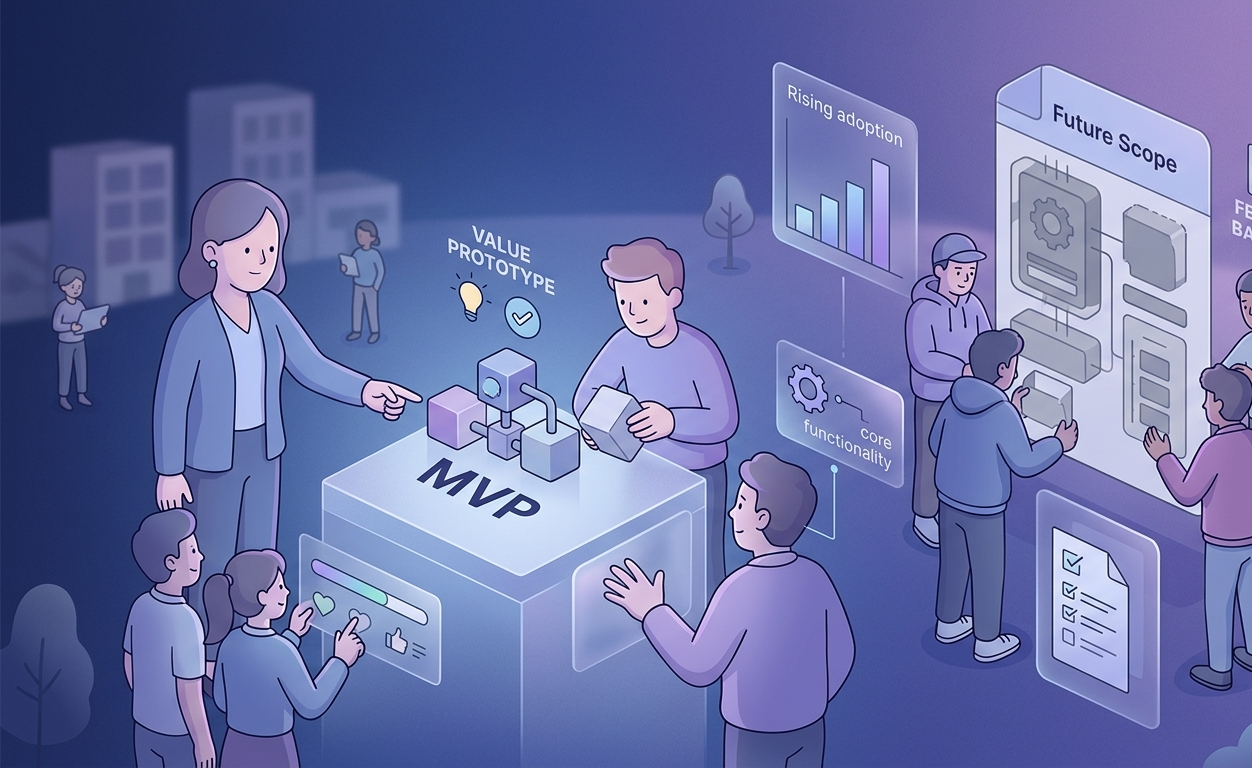
What Is an MVP? Building the Smallest Product That Creates Value
Every successful digital product begins with a vision. A company identifies an opportunity, imagines a solution, and starts thinking about the features that could transform that idea into reality. The excitement of building something new can be powerful, but it can also create one of the biggest challenges in software development: building too much before knowing whether people actually need it.
Many products fail not because the technology was poor or the team lacked skill, but because organizations invested significant time and resources into creating solutions before validating the underlying idea. They built advanced features, polished interfaces, and complex systems only to discover that customers were looking for something different.
A Minimum Viable Product (MVP) is designed to solve this challenge. It represents the smallest version of a product that delivers meaningful value to users while allowing businesses to learn from real-world feedback. The purpose of an MVP is not to release an incomplete product. It is to create the fastest path toward understanding what works, what needs improvement, and what customers truly value.
The Purpose of an MVP Is Learning, Not Just Launching
The term "Minimum Viable Product" is often misunderstood. Some people interpret it as creating a basic or unfinished version of software and releasing it as quickly as possible. However, the real purpose of an MVP is not simply speed.
An MVP is a learning tool.
Before investing months or years into development, companies need evidence that their idea solves a meaningful problem. An MVP allows them to test assumptions, observe user behavior, and gather insights before committing further resources.
This approach changes the way companies think about development. Instead of asking, "How do we build the complete product?" teams begin by asking, "What is the smallest version of this idea that can help us learn whether we are moving in the right direction?"
The goal is not to build less because quality does not matter. The goal is to avoid spending effort on features and systems that may never create value.
Why Building Everything at Once Creates Risk
One of the most common mistakes in software development is attempting to build the final version of a product from the beginning. Teams imagine every possible feature users might need, design complex architectures, and spend significant time preparing for a future that has not yet been validated.
This approach creates several problems. Development becomes slower because the scope continues expanding. Teams invest resources into features that may never be used. Most importantly, they delay receiving feedback from the people who will actually use the product.
Software development always involves assumptions. Companies assume they understand customer needs, they assume users will interact with features in certain ways, and they assume the market will respond positively. The longer a team builds without feedback, the more expensive it becomes to discover that those assumptions were incorrect.
An MVP reduces this risk by bringing real users into the process earlier.
MVP Does Not Mean Low Quality
A common misconception is that an MVP is simply a poorly built version of a product. This misunderstanding can lead companies to create software that feels unreliable, confusing, or unfinished.
The difference is that an MVP has a focused scope, not poor execution.
A well-designed MVP should still provide a smooth user experience, reliable functionality, and a clear solution to a specific problem. It does not include every possible feature, but the features it does include should work effectively.
For example, a company creating a project management platform does not need to build advanced analytics, artificial intelligence recommendations, complex automation, and dozens of integrations in its first version. The MVP might focus on the core problem: helping teams organize tasks and collaborate effectively.
The product is smaller, but the value is still real.
The Difference Between a Prototype and an MVP
Although prototypes and MVPs are often discussed together, they serve different purposes.
A prototype is primarily used to explore an idea. It helps teams visualize concepts, test designs, and understand how a product might work before development begins. It may not include functional software or real users.
An MVP, on the other hand, is an actual product that users can interact with. It exists in the real environment where teams can measure behavior, collect feedback, and understand whether the solution creates enough value.
Both are valuable parts of the development process, but they answer different questions. A prototype asks, "Could this idea work?" An MVP asks, "Does this solution create enough value for real users?"
Building an Effective MVP
Creating an MVP requires discipline because the biggest challenge is deciding what to exclude. Teams often struggle because every feature feels important, especially when they are passionate about their idea.
The first step is identifying the core problem the product needs to solve. A successful MVP should focus on the smallest set of capabilities required to address that problem.
The second step is understanding what success looks like. Companies need clear measurements that help determine whether the product is creating value. This could include user engagement, customer feedback, retention, or other meaningful indicators.
The final step is creating a feedback loop. An MVP is not the end of development. It is the beginning of a continuous process where teams learn, improve, and gradually expand the product based on real evidence.
A Simple Example of MVP Thinking
Imagine a company wants to create a food delivery platform. The initial vision includes restaurant discovery, customer reviews, loyalty programs, personalized recommendations, subscription plans, and advanced delivery tracking.
Building all of these features immediately would require significant time and resources.
Instead, the company starts with an MVP focused on the essential problem: allowing customers to order food from nearby restaurants. Users can browse available options, place orders, and receive deliveries.
After observing real customer behavior, the company learns what matters most. Perhaps customers care more about delivery speed than restaurant variety. Perhaps they need better order tracking rather than more choices.
The MVP provides something more valuable than a product launch.
It provides knowledge.
The Role of Engineering in MVP Development
An MVP may be smaller than a complete product, but engineering decisions still matter. Poor technical foundations can create problems when the product begins growing, making future improvements slower and more expensive.
The challenge is finding the right balance between speed and quality. Teams should avoid unnecessary complexity while still building software that can evolve.
Good engineering practices allow companies to validate ideas quickly without creating systems that collapse as soon as they gain traction. The goal is not to over-engineer an early product, but to create a foundation that supports future growth.
A successful MVP is not just a quick experiment. It is the first version of a product designed to become something greater.
Final Thoughts
An MVP is more than a smaller version of a product. It is a strategic approach to software development that helps companies validate ideas, understand users, and create better solutions.
By focusing on the essential problem first, businesses can avoid unnecessary complexity and build products that are shaped by real customer needs rather than assumptions.
Great software is not created by building everything at once. It is created by understanding what matters, building with purpose, and continuously improving over time.
Build Software That Is Designed to Last
Creating successful software requires more than writing code and delivering features. It requires a complete approach that combines strategy, user experience, architecture, engineering, and continuous improvement.
At DevStudio, we help businesses transform ideas into scalable digital products by focusing on the principles that define great software. From understanding the problem and designing the user experience to building reliable systems that can grow with your business, we create solutions designed for long-term success.
Whether you are launching a new product, modernizing an existing platform, or building custom software from the ground up, DevStudio provides the expertise and development process needed to turn ideas into powerful digital solutions.
Build software that is not only functional, but built to grow with DevStudio.